
When Your Husband Is Always on His Phone
If scrolling is getting in the way of feeling close, a clear conversation and a small shared plan can help.
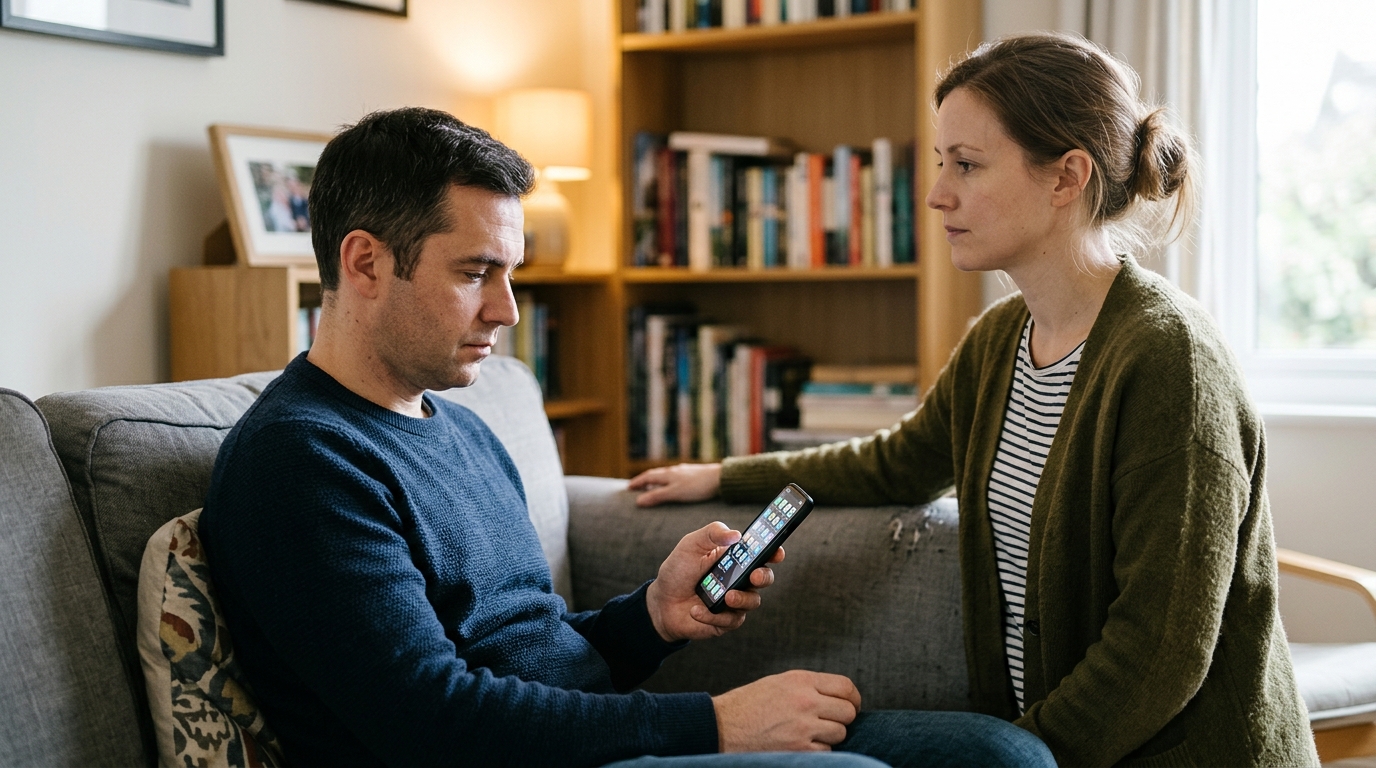
You're halfway through a story about your day when you notice your husband nodding at his phone. You stop talking. A few seconds later, he looks up and asks you to repeat the last bit.
Once in a while, it's an ordinary distracted moment. When it happens at breakfast, on the sofa and again while you're making weekend plans, it can leave you feeling lonely. You don't have to pretend it doesn't bother you, and you don't have to decide what it means before you've talked about it.
Ask what's holding his attention
A phone can hold a work message, a group chat, a game, a shopping list and a stream of videos. From across the room, they can all look much the same. Before deciding why he's absorbed, try asking what keeps pulling him back to the screen.
Perhaps work is spilling into the evening, or he's waiting for news from a family member. Maybe he opens one message and keeps scrolling without quite deciding to. You may recognize that habit in yourself, too. These are possibilities, not explanations for what's happening in your marriage.
You might sit down with him after dinner and say, “I've noticed you're on your phone a lot in the evenings. Is something going on, or has it just become a habit?” Give him room to answer, even if his first response isn't the one you expected.

Curiosity doesn't mean swallowing your frustration. You can care about why he's checking his phone and still want more attention when you're together. If he says he's waiting for a work message, for example, you might ask when he'll be free to talk rather than dropping the subject altogether.
If you're worried he's talking to someone else, that fear deserves a conversation too. Phone use alone doesn't tell you whether he's being unfaithful. Try naming the uncertainty rather than presenting a suspicion as a fact: “I've been feeling disconnected, and I'm worrying about what that means for us.” You can ask for reassurance without demanding to read every message. You may also need to talk about what privacy and trust mean to each of you.
Say what you miss
Choose a moment when neither of you is rushing out the door or already arguing. You don't have to wait for a perfect afternoon. Even a few quiet minutes after dinner can be enough to start.
Be specific about what happened and how it landed. “You never listen to me” leaves plenty of room to argue about exceptions. “When I told you about my appointment last night and you kept scrolling, I felt brushed aside” gives him an actual moment to understand.
Then make a request he can respond to: “I'd like us to put our phones down when we're talking about something important. Would you be willing to try that?” You aren't asking him to account for every minute he spends online. You're asking for attention during a particular kind of conversation.
Listen to his side, including whether there are times he feels interrupted by your phone. Perhaps he thought you were sharing a quick update when you wanted a longer conversation. That doesn't make your feelings wrong; it gives you both more to work with.
If the discussion gets tangled, you can pause without abandoning it. Try, “I don't want us to fight about one evening. Can we come back to this after dinner tomorrow?” Naming a time to return makes the pause feel less like another dismissal.
Agree on one phone-free moment
A sweeping ban may sound appealing when you're fed up. It can also be awkward if one of you is on call, waiting for family news or using a phone for everyday tasks. Start with something small enough that you both want to try it.
Pick a moment that matters to you. Perhaps phones go on the kitchen counter during dinner, while you sit down together and catch up. If evenings are unpredictable, a short walk on Saturday morning might suit you better. The point isn't to find the most impressive rule; it's to find a little time you can actually share.

Talk through the details. Can a phone stay nearby for an urgent call? What happens if one of you needs to check a message? You might agree to say, “I need two minutes to answer this,” instead of silently disappearing into the screen.
Make the agreement mutual. That doesn't mean your original concern was unfair. It means you're both looking after the time you've set aside. Try it for a week, then ask each other what worked. If dinner without phones felt forced, perhaps tea together later in the evening will feel more natural.
Not every shared moment has to be profound. A few minutes spent laughing about a grocery-store mishap or deciding what to cook tomorrow can be worth protecting, too. Leave room for companionable quiet as well; putting a phone away doesn't create an obligation to fill every silence.
Stop repeating yourself to a screen
You can ask for attention without performing for it. If you start talking and he's still scrolling, try a calm interruption: “I'd like to tell you something, but I'd rather wait until you're free to listen. When would be a good time?”
If he needs to finish a task, agree on a time to return to the conversation. “After I send this email” is useful only if you both come back to it. You could say, “All right, I'll make tea. Can we talk when you're done?” Then go ahead with your evening rather than standing there waiting.
If the moment keeps getting postponed, bring that up separately. “We said we'd talk after your email, but we never did. Can we make a time tonight?” is clearer than testing whether he'll remember. You're allowed to ask for follow-through, not just a promise made while his attention is elsewhere.
Having your own plans isn't a substitute for addressing loneliness in your marriage. Still, your whole evening doesn't have to depend on whether he puts down a phone. Keep the book club, take the walk or call your sister. You can make space for things you enjoy while you work out what you need from each other.
Look at what happens next
A new routine may take some adjusting. He might forget and reach for his phone, just as you might. You can remind each other of the agreement without treating every slip as proof that the conversation failed.
Look at the wider response over time. Does he make room to hear you, even if he sees things differently? If he's genuinely occupied, does he suggest another time and come back to it? Are you both keeping the agreements you make? Those ordinary moments give you something more useful to discuss than a promise made in the middle of an argument.
If he repeatedly mocks your feelings, refuses to discuss the issue or makes you feel afraid to raise it, the concern is bigger than a device. You don't have to sort that out alone. Consider talking with someone you trust or seeking individual support. If you both want help talking through the distance, a couples counselor may be an option.
For tonight, you might begin with one invitation: “Could we put our phones away while we have tea? I miss hearing about your day.”
This article is general guidance and not professional, legal or financial advice.